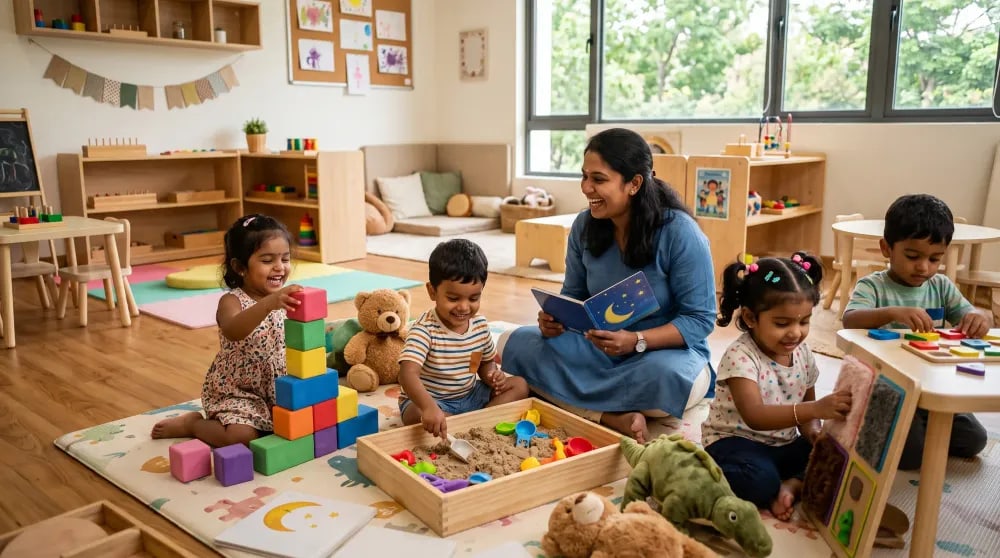
Nursery is the year curiosity takes off. Children who arrived shy are suddenly asking why the sky is blue, why the cat has whiskers, and whether they can please have the red crayon. Our nursery school in Thoothukudi is built to feed that curiosity rather than sit it down.
At three and four, a child's brain forms connections at a rate it will never match again. But that growth happens through play, not through worksheets. So a nursery child at Little Stars learns to count by laying the table, learns rhythm by clapping a song, and learns letter sounds by hunting for them in a story.
By the end of the Nursery year, most children recognise letters and their sounds, count confidently, name colours and shapes, hold a crayon with control, and — most importantly — believe that learning is fun.
Pre-reading and phonics through songs and stories
Numbers, shapes, colours and sorting games
Art, craft and music — building fine motor control
Speaking and listening in front of a group
Confidence is the real subject
The quietest child in the room in June is often the one hosting a rhyme on stage by March. We work on that deliberately: small speaking turns, group activities, jobs and responsibilities, and a lot of noticing out loud when a child does something brave.
Confidence built at this age tends to stay. It is the single thing parents thank us for most.
A typical Nursery day
The day opens with a circle: a good-morning song, a look at the weather, a count of who came today. It sounds small, but it teaches sequence, attention and belonging all at once.
From there the room splits into activity corners — a phonics game in one, building blocks in another, painting in a third — and children rotate through them with a teacher alongside. There is a snack, a run around outside, a story, and a calm finish before home time.
Nothing in that day is accidental. Every corner has a purpose, and every teacher knows what each child is meant to be gaining from it.
How we keep parents informed
You should never have to guess how your child's week went. We share regular updates, we're reachable on WhatsApp, and if something is worrying us — a shy patch, a speech delay, trouble with sharing — you will hear it from us early and plainly.
Nursery is often the year small difficulties first become visible. Caught early, most of them simply resolve.
Questions parents ask
What is the difference between Playgroup and Nursery?
Playgroup (2–3) is about settling, comfort and sensory play. Nursery (3–4) adds early structure — phonics, numbers and group learning — while still being play-led.
Will my child learn to read in Nursery?
Most children begin recognising letters and their sounds, and some start blending simple words. Formal reading builds properly in LKG. We never push a child ahead of their readiness.
Give your child a happy place to begin
Seats for the new academic year are filling fast. Talk to us today — we'd love to meet your little star.